問題詳情
PART B. SCIENTIFIC REASONING每題10分Coral Reef Ecosystems: Peter J. Mumby and collaborators (2007) analyzed and modeled mechanismscausing the contemporary decline of Caribbean corals. They showed that macroalgal growth has a negativeeffect on coral growth and that the growth of macroalgae is, itself, controlled by herbivores such as urchins(Diadem
(A) and parrotfishes. Authors modeled the system at high and low levels of grazing (Figure 1).
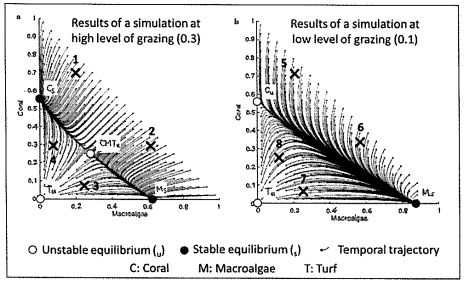
Figure 1. Phase planes showing equilibrium covers of macroalgae and corals and trajectories over time forsimulations at a high level of grazing (a) or a low level of grazing (b). Adapted from Mumby et al. (2007).
The same model allows representing the % of coral cover as a function of the grazing (Figure 2). Thetrajectory of reefs in Jamaica such as observed between the 1970s and the 1990s is overlapped using bluearrows in the figure.
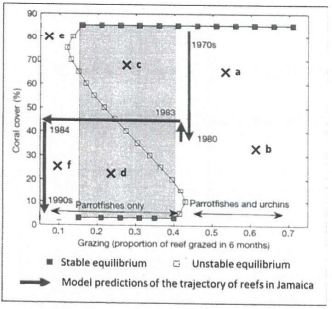
Figure 2. Stable and unstable equilibria for Caribbean coral reefs. Stable and unsrable equitibria are denored byspriate dates, rep solid and open squares, respectively. Bhue lines. marked with approp epresent model predictions of thetrajectory of reefs in Jamaica (see also Figure 3). Adapted from Mumby et al. (2007).
Figure 3 represents the changes in coral cover (%) since the 1970s with the indication of the events thatcould have influenced those changes.
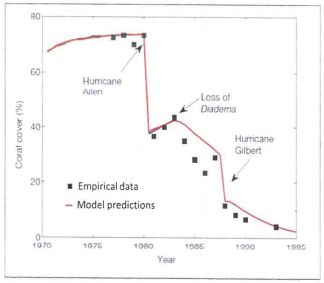
Figure 3. Comparison between model predictions and empirical data for the trajectory of sructurally complexforereefs in Jamaica at a depth of 10 m. The model was run with an algal coral overgr overgrowth rate of 14 cm2 yr1.Diadema is a genus of sea urchin and an important grazer on Caribbean reefs. Adapied from Mumby et al. (2007).
Reference: Mumby PJ. Hastings A. Edwards, HJ (2007) Thresholds and the resilience of Caribbean coral reefs.Nature 450. 98-101. https://doi.org/10.1038/nature06252