問題詳情
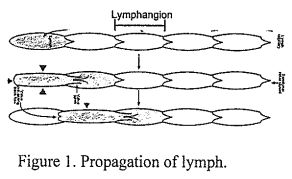
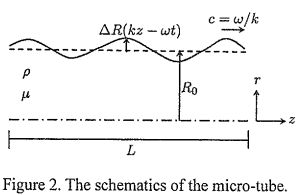
1.(50%) Lymphangions(淋巴管節),functional units of a lymph vessel(淋巴管)that lie between two semilunar values (瓣膜), aremuscular and capable of contracting themself one by one to propel the lymph(淋巴液) forward and increase the fluid pressure(figure 1). A lymph vessel now is modeled by a micro-tube with a deformable wall as shown in figure 2. The micro-tube has afixed length L and a radius R0 when the wall is undeformed. We assume that a lymph vessel is very thin, Ie., R0 << L. Wemodel the operations of lymphangions as a wall deformation in a form of traveling wave, i.e, △R = △R(kz - ωt), where z isthe streamwise coordinate, k and ωare wavenumber and angular velocity of the traveling wave, whose traveling velocity isc = ω/k. Thus, the deformable wall is described by an axisymmetric surface at r = R(z, t) = R0 + △R(kz - ωt). Consider theflow of lymph in the micro-channel is incompressible, axisymmetric and without swirling. The lymph is assumed to haveconstant densityρ and dynamics viscosity μ.
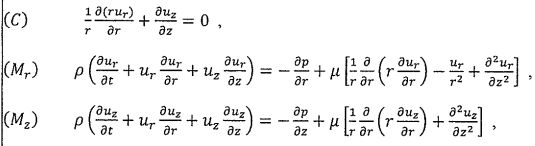
The following incompressible axisymmetric no-swirling Navier-Stokes equations in the cylindrical coordinate will be helpful:
【題組】(1) (5%) Let the scales of the streamwise and radial velocities of the lymph flow be U and W, respectively. Let the streamwise and radialpositions in the lymph flow be scaled by R0 and L, respectively. From scale analysis of the continuity equation, what can you tell about themagnitudes of U and W?