問題詳情
(二)(28~30)
There are over 300,000 monks in Thailand. Two important rules for Thai monks are: they can only have one meal a day, and they can’t eat anything after midday. But to everyone’s surprise, about half of the Thai monks are too heavy. How could it be possible?
One problem lies in the food they eat. They can’t buy food or choose food on their own, so they eat whatever the believers prepare for them. However, they give them lots of “high GI food,” such as cookies, cakes and fried rice, and this kind of food usually has lots of fat. It makes the Glycemic Index (GI) in our bodies rise pretty high in a short time and fall down quickly again. When we eat too much high GI food, we’ll get hungry easily, and our bodies will store more fat and sugar from the food. But if we have “low GI food” like vegetables or fruit, the GI will rise just a little and slowly.
The other problem lies in their unhealthy habits. They spend much time chanting and cleaning the temples, so they don’t exercise enough. And because they can’t eat any food at night, when they are hungry, they have lots of sweet drinks.
Now, the government of Thailand are asking the believers to give the monks healthier food and asking the temples to give them more time to exercise. Will they have a healthier life in the future? Let’s wait and see.
Thai monk泰國和尚 Glycemic Index (GI) 升糖指數 chant誦經 government政府
【題組】
(A) Meal 1--Line B; Meal 2--Line A.
(B) Meal 1--Line B; Meal 2--Line B.
(C) Meal 1--Line A; Meal 2--Line A.
(D) Meal 1--Line A; Meal 2--Line B.
There are over 300,000 monks in Thailand. Two important rules for Thai monks are: they can only have one meal a day, and they can’t eat anything after midday. But to everyone’s surprise, about half of the Thai monks are too heavy. How could it be possible?
One problem lies in the food they eat. They can’t buy food or choose food on their own, so they eat whatever the believers prepare for them. However, they give them lots of “high GI food,” such as cookies, cakes and fried rice, and this kind of food usually has lots of fat. It makes the Glycemic Index (GI) in our bodies rise pretty high in a short time and fall down quickly again. When we eat too much high GI food, we’ll get hungry easily, and our bodies will store more fat and sugar from the food. But if we have “low GI food” like vegetables or fruit, the GI will rise just a little and slowly.
The other problem lies in their unhealthy habits. They spend much time chanting and cleaning the temples, so they don’t exercise enough. And because they can’t eat any food at night, when they are hungry, they have lots of sweet drinks.
Now, the government of Thailand are asking the believers to give the monks healthier food and asking the temples to give them more time to exercise. Will they have a healthier life in the future? Let’s wait and see.
Thai monk泰國和尚 Glycemic Index (GI) 升糖指數 chant誦經 government政府
【題組】
28.What might happen to the Glycemic Index (GI) after we have Meal 1 and Meal 2?
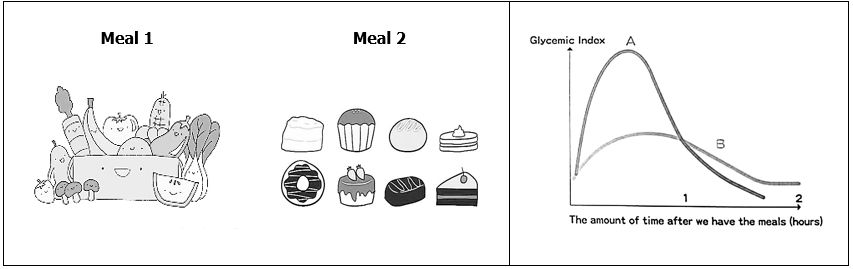
(A) Meal 1--Line B; Meal 2--Line A.
(B) Meal 1--Line B; Meal 2--Line B.
(C) Meal 1--Line A; Meal 2--Line A.
(D) Meal 1--Line A; Meal 2--Line B.
參考答案
答案:A
難度:適中0.6
書單:沒有書單,新增
難度:適中0.6
書單:沒有書單,新增
用户評論
【good_ene】評論
Meal 1 "low GI food" ☆☆☆☆ ...